Your Last Project before the Covid Shutdown
Remembering March 2020
The Covid-19 shutdown was four years ago, and everything just before seems like a blur. Do you remember what you were doing right before everything shut down? Would you want to look it up if you could? GitLab keeps a history of contributors' activities, and I looked up what I was doing.
I had created a simple project: a service that would text me when a website changed, watch-url.
So here's the thing: I'm fundamentally against having to make a service like that. I feel like any site that relies on something changing should have an RSS feed or a web service that clients can query. I try to make that clear in the Before You Start section of the README.md. So my making this thing was under protest.
Salesforce Tower Tours
At the time, Salesforce Tower in San Francisco was occasionally offering tours to the top. To get on a tour you signed up at a site, salesforcetowertours.com, when they had openings. Problem was there was no telling when they'd update the page to allow sign-ups. Anytime they opened the site for reservations, it'd fill up in minutes, and the page would revert to the "Please come back later" page.
It was practically impossible to get reservations. My wife had been trying for weeks, and was on their email list, but it wasn't getting the job done. Their site didn't have an RSS feed or a web API. So I wrote that little web service so my wife could learn when reservations were available again. It was all for Salesforce Tower tours!
Then the U.S. shut down for Covid in March 2020, and there were no more tours to the top of Salesforce Tower. There was no more point to my little script. Oh, well.
Nudging a favorite site to get RSS
Since I decided to open-source watch-url, I chose a better example site to watch in the README, not the Salesforce site. I chose Nicky Case's ncase.me, because her site is amazing, everybody should visit it, and it tragically didn't have RSS, so some fans wouldn't know if/when she posted something new. So I used it in the README example setup:
./watch_url.py https://ncase.me/
It was my way of saying that I loved her site, and I wished there were a better way to get notified whenever she updates it. (Since you can't always trust email, as Cory Doctorow pointed out when 2600's HOPE email got filtered away by Google.)
Later On, an Unexpected Win
So here I am in January 2024, reminiscing about February 2020, and bemoaning that we may never get on a tour to Salesforce Tower.
But guess what? Nicky Case added RSS to her site! I subscribed! And now I get notifications for her new posts. That's a win!
Photo by Bru-nO / Pixabay Content License
Big Two
What is this?
Big Two is a card game from China originally called Choi Dai Di, or simply Dai Di. It's fun and easy to learn especially if you know poker hands. In Big Two, both suit and rank matter, unlike Chinese Poker, which is even easier to learn. Each player tries to discard all the cards in their hand. When someone discards their last card, the others are penalized points for the cards left in their hands.
Rules
Big Two is played with a standard deck of 52 playing cards. 2 is is the highest rank so the ranking goes: 2 A K Q J 10 9 8 7 6 5 4 3. The suit order, starting from highest, is ♠ ♥ ♣ ♦. When played in straights, the two is played below a three.
Scoring varies from place to place. We usually have each player with cards remaining after a game count the number of cards they have against them.
Cutting for the First Deal
Each player selects a single card from the deck. Aces are high during the cut. The owner of the high card gets the deal. The play the rotates clockwise around the table.
Dealing
Each player is dealt 13 cards.
Playing
The player with the 3♦ starts the game. If the 3♦ isn't held by any players, then the next lowest card determines the first player.
First Play: The first player must discard their lowest card individually or as part of a valid “hand”. To make the discard, place the selected cards face up on the table to show the other players. They will have to beat this hand or pass. Valid hands are described below.
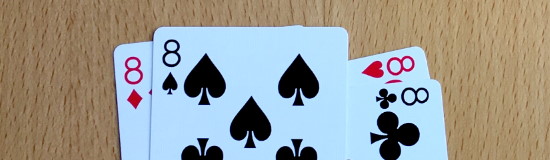
Subsequent Plays: Each subsequent player may discard a better hand of the same number of cards as the one shown on the table (if they have such a hand) or pass. For example, if the current play on the table is a pair of eights, 8♥ 8♣, the only play that may be discarded to beat that hand is another pair of a higher value. Since ♠ is the highest ranking suit, then the pair 8♠ 8♦ could beat 8♥ 8♣. All pairs of rank 9 and higher could also beat the pair of eights.
Five-card poker hands: Straights, Flushes, Full Houses, Four of a Kind (with a fifth card), and Straight Flushes can be played, and can be beaten by a higher hand of the same type or by a higher type of five-card hand. For example, a Flush beats a Straight, as does a Full House. The order is: Straight Flush > Four of a Kind > Full House > Flush > Straight .
If everyone passes, then the player who made the last play may start a new trick by discarding a new playable hand of any type. Once a player discards his last card, he has won the trick and each player has to tally his own score. The winner of the trick gets to start the next trick with any valid hand to discard he chooses.
Valid Hands to Discard
- Single Card: A single card may be discarded as a hand. 3♦ is the lowest and 2♠ is the highest.
- Pair: A single pair may be discarded as a hand.
- Three of a Kind: A single three of a kind may be discarded as a hand.
Straight: Straights must be 5 cards long. The 2 is played below a 3 in straights. A straight led by an 8♠ beats an straight led by an 8♥, as does any straight led by a higher rank than 8.
House rules vary as to whether 23456 is a high straight or a low one. The game is called Big Two, after all. Agree to your house rules before you start.
Flush: Flushes must be 5 cards long. Rank is determined by Face value of the highest card. Suit (♠ ♥ ♣ ♦) is used to break ties.
A common alternative house rule is: A flush in a higher suit beats a flush in a lower suit regardless of the ranks of the cards. Otherwise the rank of the highest card determines which flush beats another of the same suit.
- Full House: A pair accompanied by a three of a kind. The value of the full house is determined by the three of a kind. (99944 beats 777KK because 9s are higher than 7s.)
- Four of a Kind: Four of a kinds must be played with a fifth card. The value of the fifth card does not matter. (E.g., 6JJJJ beats 84444 because Js are higher than 4s.)
- Straight Flush: The value of the straight flush is determined by its highest card.
Scoring
While scoring varies from place to place, here's one way: Each time somebody has won a round, the other players have to count the number of their remaining cards, and add points to their current score according to the following rules:
- All cards caught in the hand: 50 points.
- All cards but one caught in the hand: 40 points.
- All cards but two caught in the hand: 30 points.
- Otherwise: Add 1 point for each card caught in the hand.
History
The game was taught to us by Derek and Pei Fluker in Silicon Valley in the 1990s.
From Wipeout to Devs
Wipeout
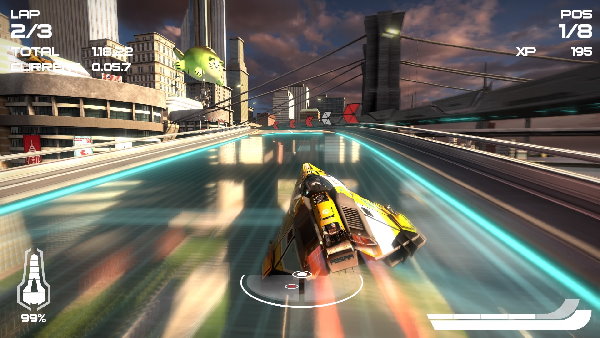
In 1995, the PlayStation game Wipeout was released, and its influence was massive. It had great playability, music and visuals. The clean and futuristic visuals were designed by The Designers Republic and they were incorporated into all parts of the game, advertising copy and at least one music video.
The music of Wipeout included works by the Chemical Brothers, Fluke, and The Prodigy. The official music video for Fluke's "Atom Bomb" revolves around Ariel Tetsuo, one of the characters in Wipeout. it's a combination of in-game video, animation, effects, and live video suitable for a screening at a rave party.
For years, when returning from San Francisco on an empty 280 freeway with racetrack curves, I'd play Atom Bomb (or just remember the tune) and be reminded of flying by on a Wipeout course looking for imaginary power-up pads.
The Chemical Brothers
Wipeout got me further interested in electronic and techno music from artists like The Chemical Brothers. The Chemical Brothers have a history of innovative music video from creative directors like the legendary Michel Gondry. Their video for "Wide Open" ft. Beck stars Sonoya Mizuno dancing alone in a warehouse as parts of her body become 3D-printed lattice constructions – in one amazing four and a half minute shot. It was directed by Dom & Nic.
The video is worth watching. The music and the dance are haunting on their own, and her transformation to the printed lattice self is on another level. It's amazing.
Fx Guide has an excellent, deep article on the making of that music video, So, just how was that Chemical Brothers video made? There is also a worthy four-minute documentary, "The Chemical Brothers - The Making Of Wide Open" on YouTube:
FX's miniseries Devs
I was already a huge fan of the original series on FX Legion. So when I heard people raving about a new miniseries called, "Devs", I was very willing to give it a chance.
I've just started Devs and it looks to be really good. The main character is played by Sonoya Mizuno, the dancer from "Wide Open"! Oh man, there's nothing but positive associations there for me going all the way back to 1995. Everything from FX, Sonoya Mizuno, to the Chemical Brothers all the way back to Wipeout.
I really hope I like the rest of Devs. ^_^;
PSNation was the source for the Wipeout image.
Chinese Poker
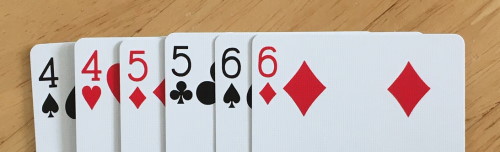
What is this?
This is a fun card game that’s easy to learn. Each player tries to discard all the cards in their hand. When someone discards their last card, the others are penalized points for the cards left in their hands.
If you like Chinese Poker, you may want to try Big Two next.
Rules
Before playing, the players agree to play to a certain score maximum. (Usually 100.) Once any player reaches the maximum the game is over. The player with the lowest score is the winner.
Chinese Poker is played with a standard deck of 52 playing cards. Three 2s and one ace are removed, leaving a deck with 48 cards. Suits and color do not matter. Only the values of the cards matter. Aces beat kings. When played individually, the two is the high card. (It will beat an ace.) When played in straights, the two is the low card.
Cutting for the First Deal
Each player selects a single card from the deck. Aces are high during the cut. The owner of the high card gets the deal. The dealer also gets to make the first play. (“Plays” are described below.) The play the rotates clockwise around the table.
Dealing
- 2 Players: The dealer deals out 3 hands of 16 cards each. Then the dealer gets to choose any one of the three hands. The other player then gets to select one of the remaining two hands.
- 3 Players: The dealer deals out 3 hands of 16 cards each. Each player plays the hand they are dealt.
- 4 Players: The dealer deals out 4 hands of 12 cards each. Each player plays the hand they are dealt.
Playing
First Play: The current player may discard a valid “hand” from his whole hand, or choose to pass. To discard a hand, place the selected cards face up on the table to show the other players. They will have to beat this hand or pass. Valid hands are described below.
Subsequent Plays: Each subsequent player may discard a better hand of the same type as the one shown on the table (if they have such a hand) or pass. For example, if the current play on the table is a pair of 8s, the only play that may be discarded to beat that hand is another pair of a higher value (9s and up). (Four of a kind is a wild hand, an exception, and is described below.)
If everyone passes, then the player who discarded the most recent hand may discard a new hand of any type. (As in the first play.) Once a player discards his last card, he has won the round and each player has to tally his own score. The winner of the round gets to deal the next round. (This can be very frustrating if you’re not the winner!)
Valid Hands to Discard
- Single Card: A single card may be discarded as a hand. 3 is the lowest and 2 is the highest.
- Pairs: A single pair, or sequential pairs, may be discarded as a hand. Any number of pairs may be discarded in a hand, as long as they are sequential. (E.g., 445566 is a valid hand, while 445577 is not because 7 does not come immediately after 5.)
- Three of a Kinds: As pairs, three of a kinds may be played individually, or in groups of sequential values. (E.g., 333444.)
- Full House: A pair accompanied by a three of a kind. Only the value of the three of a kind needs to be beaten in the subsequent play. (99944 beats 777KK because 9s are higher than 7s.)
- Straight: Straights must be at least 5 cards long. They may be as long as 13 cards. The 2 is the low card in straights. To beat a straight, you must play a higher straight of exactly the same number of cards. (E.g., 456789 beats 345678.)
- Four of a Kind: Four of a kinds must be played with a fifth card. The value of the fifth card is the value to be beat by another four of a kind. (E.g., 84444 beats 6JJJJ because 8s are higher than 6s.) Four of a kinds are wild hands and may be played on any other kind of hand!
Scoring
Each time somebody has won a round, the other players have to count the number of their remaining cards, and add points to their current score according to the following rules:
- All cards caught in the hand: 50 points.
- All cards but one caught in the hand: 40 points.
- All cards but two caught in the hand: 30 points.
- Otherwise: Add 1 point for each card caught in the hand.
History
The game was taught to us by Derek and Pei Fluker. We know this is not the same as another gambling game called Chinese Poker.
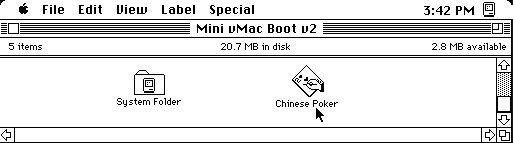
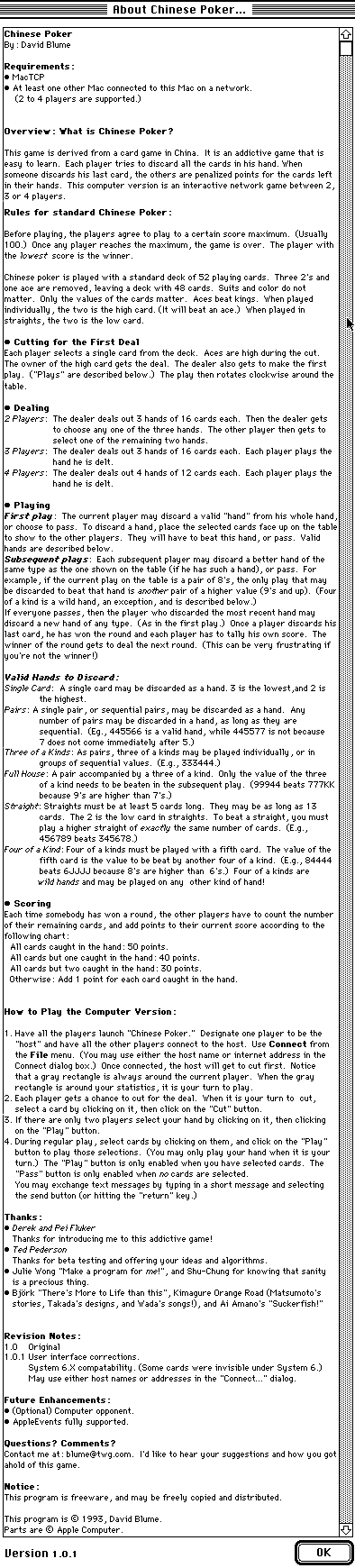
In 1993, I created what may be the world’s first online card game with a GUI interface. Here’s the “About” window for the classic Macintosh version.
Still not Defeated

Every few years, disparate web services seem to conspire to shutdown or break at the same time. It happened again last month. Some of them you may have heard of, but the others broke or disappeared without any prior announcement. I've been through this sort of thing before, so I knew it'd eventually take a little work to keep my services humming along again.
Google Plus
Google Plus announced that they'd shut down their service ten months before doing so. That gave me a few months to avoid addressing the issue, and then eventually getting around to backup up my posts. I love my backup, it's so much faster to load and navigate than Google's service.
Google Image Charts
Google Image Charts gave us seven years to prepare for their shutdown. They even staged one short and one long outage to draw our attention to the upcoming closure. I ignored it the whole time, and then scrambled to find a replacement after the permanent closure.
FourSquare Activity Feeds
FourSquare shut down their user activity feeds without any notice. They were in a sort of limbo as they tracked Swarm activity, but the URLs were still FourSquare. The feed was very important to me because I maintain a lifestream. I became a FourSquare developer to access my content, and discovered that I could make a more informative feed on my own than the feed they'd just killed. Yay! That turned out to be an unexpected win.
Internal Server Errors
My shared web hosting service started suffering intermittent "internal server errors" (HTTP code 500) at the same time as the above changes. I turned off FastCGI, but that didn't help. Then I upgraded PHP from 5.6 to 7.2, which broke my blog engine (Habari), so I fixed that, but the "500"s kept happening. As a last resort, DreamHost moved my site from Virginia to some new servers in Oregon. That fixed the issue, and even better, upgraded my account to a Linux distro that uses Python 3.6! Yay, that means I finally get to use f-strings at DreamHost! DreamHost was the last place where I couldn't use f-strings, so I'm really happy that they've caught up.
Despite the handful of shutdowns and failures, I ended up with a couple of unexpected wins over the previous situation, so I'm pretty happy about that.
Photo by Andrew Wallace / CC BY-NC-ND 2.0
 Entries